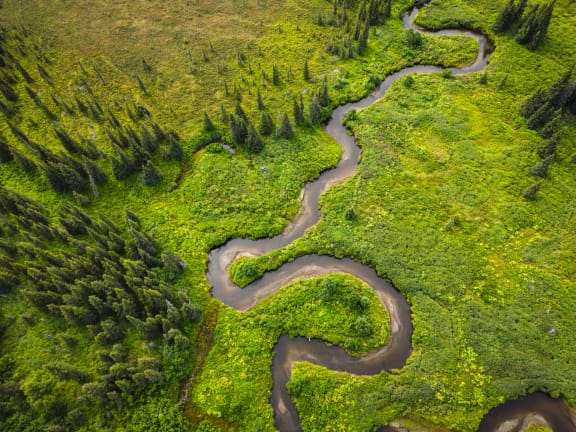
Did You Know That Fish Need Land, Too?
November 12th, 2026A Season of Giving with the Kachemak Heritage Land Trust
Just up the road from Homer, Alaska, there’s a little town called Anchor Point (which, ironically, I didn’t even realize when I first named this newsletter Anchor Points!). Just outside that town runs Stariski Creek, a small coastal stream whose watershed is home to wild salmon in the Kenai Peninsula. And that watershed is the subject of and inspiration for this week’s letter.
This holiday season, we’re supporting conservation efforts for Stariski Creek through a special seafood gift box: the Salmon Stewardship Box! For every box purchased, Wild Alaskan Company will give 10% to the Kachemak Heritage Land Trust’s Stariski Creek Salmon Habitat Fund. The fund will cover whatever it takes to protect water and salmon habitat in the watershed, along with other conservation and stewardship needs there.
But first, some basics to get you oriented: a watershed (also called a drainage basin) is an area of land where all the rain and melting snow drain into the same body of water, like, case in point, Stariski Creek. Every salmon begins its life’s journey in a stream like Stariski, and many return to it later to spawn and die. What I really want to emphasize is that what happens in that stream truly depends on the land around it — which is why you might hear the expression, fish need land, too.
Trees along the banks shade the water and keep it cold, the way salmon need it. Their roots hold the banks in place, so soil doesn’t wash in and disturb the fish eggs tucked into the gravel. Wetlands soak up rain and snowmelt, filter it, and let it out slowly, which keeps the creek clean and flowing through dry spells. Even the insects that drop from overhanging branches become food. All of it gives baby salmon (from alevin to fry to parr to smolt) the best chance at maturing so they can make their mystical migration to the sea.
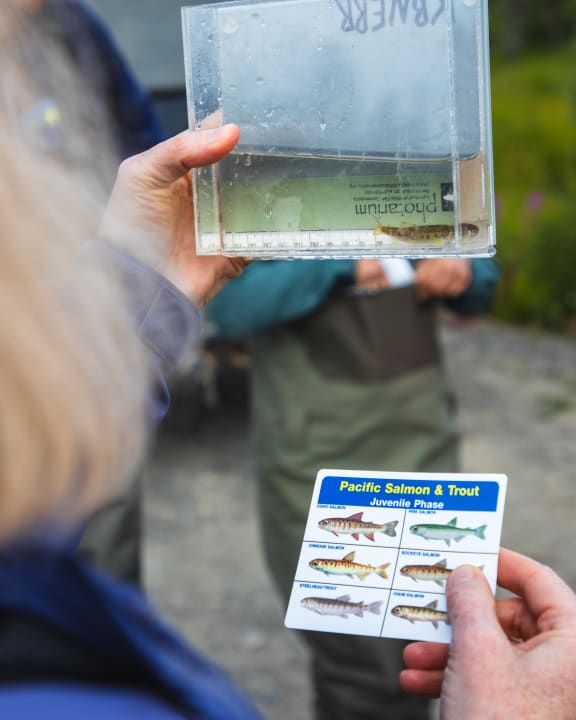
Caption: Observing baby salmon, with the help of an identification guide.
This past summer, the WAC team had the great privilege of attending a field trip to Stariski Creek, guided by Kachemak Heritage Land Trust, Alaska’s first land trust, a non-profit that works with willing landowners to protect important and irreplaceable lands on the peninsula for the future. Our visit to the creek — besides getting to see baby salmon smaller than an inch in size, or tread upon the otherworldly earth of the peat moss that feels like a carpet of wet sponge beneath one’s feet — was a crucial lesson in more deeply understanding the natural dynamics of salmon’s habitats. We know that salmon spend most of their lives in motion, but in order for them to spawn, the salmon need perfect conditions — the right temperature and the right balance of nutrients. We understood that while the creek and its environs might seem in the middle of nowhere, it's actually someone’s backyard. Which means that landowners who are aware and educated on how to keep this balance of nutrients in check can play a pivotal role in protecting the salmon.
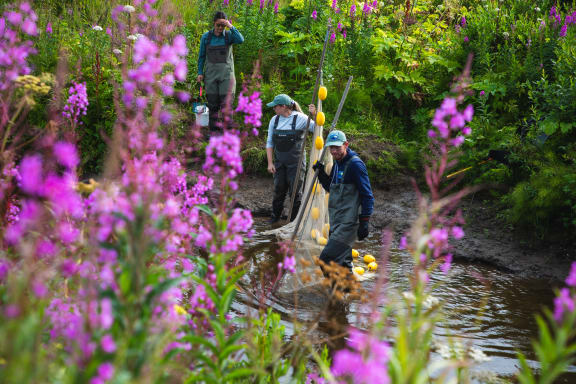
Caption: A step off the wetland and into the water, with fireweed all around.
I like to think that if WAC was created to optimize the process and experience of eating the highest quality Alaskan seafood — and thanks to such efforts by the Kachemak Heritage Land Trust, the fish, too, benefit from habitats that keep them optimized for generations to come. Adding the Salmon Stewardship Box to your gift-giving list this season helps support this incredible organization’s work by giving 10% back.
If you have any questions about the Salmon Stewardship Box or any of the other gifting options — how to send them, when they’ll arrive at your giftee’s doorstep, which box is right one — please reach out to the Member Experience team. I hope it goes without saying that we love celebrating the holidays with wild-caught Alaskan salmon as the centerpiece, so we’re especially thrilled to be sharing such a special gift box with you! A gift box that gives back to the salmon.
Live Wild,
Monica
Pictured above: A bird's eye view of Stariski Creek, winding its way through peat moss, evergreens, and patches of wildflowers. You can almost see the transfer of energy taking place in this vibrant watershed, an infinite exchange between earth and water. Photo by Lobo Brand Shop, courtesy of Kachemak Heritage Land Trust and Kachemak Bay National Estuarine Research Reserve.