Here’s What to Do If You’ve Overcooked Your Fish
February 4th, 2026My Humble Advice for Flakier, Tastier Results
If you’re a home cook, you know that overcooking happens. It’s just something that can occur in the course of domestic culinary life, and even in the finest professional kitchens. Toast that’s a little too toasty. Roasted veggies that have picked up a little too much color. An egg yolk that’s a little too set. And, of course, fish that’s a little too dry.
When I married Arron, WAC founder & CEO, I also happened to be vowing “I do” to a freezer full of wild-caught Alaskan seafood. Needless to say, I’ve cooked fish hundreds of times — and I’m happy to admit that I’ve overcooked it at least a few of those times, especially when it was a new-to-me protein.
I’ve learned a thing or two since then, so I’d love to share a few key pieces of advice:
Check your time and temp. If you’re new to cooking seafood, it’s worth checking out our team’s recommendations for total cooking time and cooking temps that works best for each species — plus, any specific techniques tailored to each cooking method. It might sound like a lot, but it’s truly just a matter of making slight adjustments here and there. A tad more heat. A little extra prep. Plus or minus a minute of cooking time. To help you out, check out our guide to internal cooking temperatures for fish, which will give you an idea of how to dial in the doneness using an objective measurement.
When possible, seek out wild salmon recipes. Generally, if you’re following a salmon recipe that doesn’t specify “wild” salmon, it’s likely written with farmed salmon in mind. And this practically guarantees overcooked results. That’s because wild and farmed salmon cook very differently — owing, largely, to differences in fat content. In short, farmed salmon often have an unnaturally high level of fat because of the unnatural conditions in which they’re produced. My advice is to stick to wild salmon recipes when you can (there’s plenty to explore via the WAC blog and app). Or, if you’re following a non-wild salmon recipe, a good rule of thumb is to reduce cooking time by about 25%. It’s not a guaranteed fix, but should help you dial things in.
Try a gentler cooking method like poaching or steaming. I believe that every cooking method presents an opportunity to cook perfectly flaky, tender fish. However, some methods are bound to give you a little more grace. Poaching fish in gently simmering liquid, whether in a soup or in a sauce, infuses the fish with both flavor and moisture. Steaming involves higher temperatures, but is also a moist cooking method. I especially love steaming fish in a pouch of parchment (also known as en papillote) which is a fun way to combine any species with tender veggies, your choice of aromatics, and a bit of oil or butter. Our Pacific Halibut with Lemon & Herb Butter pairing is practically begging for you to cook it this way — it all but guarantees that you’ll never eat dry halibut again.
Whip up a sauce. All of the steps above can help you avoid overcooking fish in the first place. But what to do when you’ve already overcooked it? Whip up a quick emergency batch of sauce. Remoulade is a zesty option — you can improvise if you don’t have all of the ingredients. Or try something different with a maple-sesame mayo. Even that store-bought pesto that you have stashed in your fridge can be a really good option.
Embrace fish cakes. If all else fails, flake up your overcooked fillet and turn it into fish cakes. It’s a clever, convenient, and delicious way to repurpose any fish — even if it was a tad dry to enjoy in its full fillet form. I like this recipe for baked fish cakes, but you can also pan-fry them if you’re comfortable going rogue and adapting the recipe for your stovetop (a little olive oil, medium heat, then fry them up 3-4 minutes a side).
I hope these tweaks, tips, and tricks inspire you to cook your next meal with a sense of curiosity and anticipation — I have a strong hunch that it’s going to be your flakiest, most tender portion of fish yet.
Live Wild,
Monica
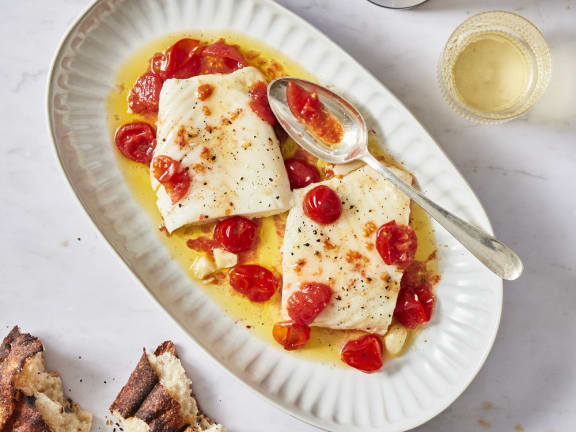
Pictured above: A platter of oil-poached Pacific halibut with burst cherry tomatoes and garlic. Here’s a bonus tip for those of you who have scrolled all the way to the caption — try “slow-roasting” fish at a relatively low temperature. It will retain a lot more moisture and develop a silkier texture. It’s a great cooking method, even if you’re not troubleshooting overcooked fish.